Sets and Venn Diagrams with Toys: A Fun, Hands-On Math Game
This post may contain affiliate links.
There are so many fun ways to make math meaningful, and this simple sets and Venn diagrams activity with toys is one of our favorites. It’s perfect for hands-on learners and helps kids grasp an abstract math concept in a visual and interactive way.
What Are Sets and Venn Diagrams?
A set is simply a group of things that have something in common. For example, a set of animals, or a set of red toys.
A Venn diagram is a type of graphic organizer that uses overlapping circles to show how sets are related. It’s a powerful visual tool for sorting, comparing, and grouping objects based on shared and differing characteristics.

How to Teach Sets and Venn Diagrams with Toys
We started this activity by reading a fun and educational book called If You Were a Set by Marcie Aboff. It introduces kids to the idea of sets in everyday life and includes helpful definitions and examples.
Materials Needed:
-
Yarn or string to make circle outlines- or use hula hoops
-
A variety of small toys or learning manipulatives
-
A large floor or table space
Instructions:
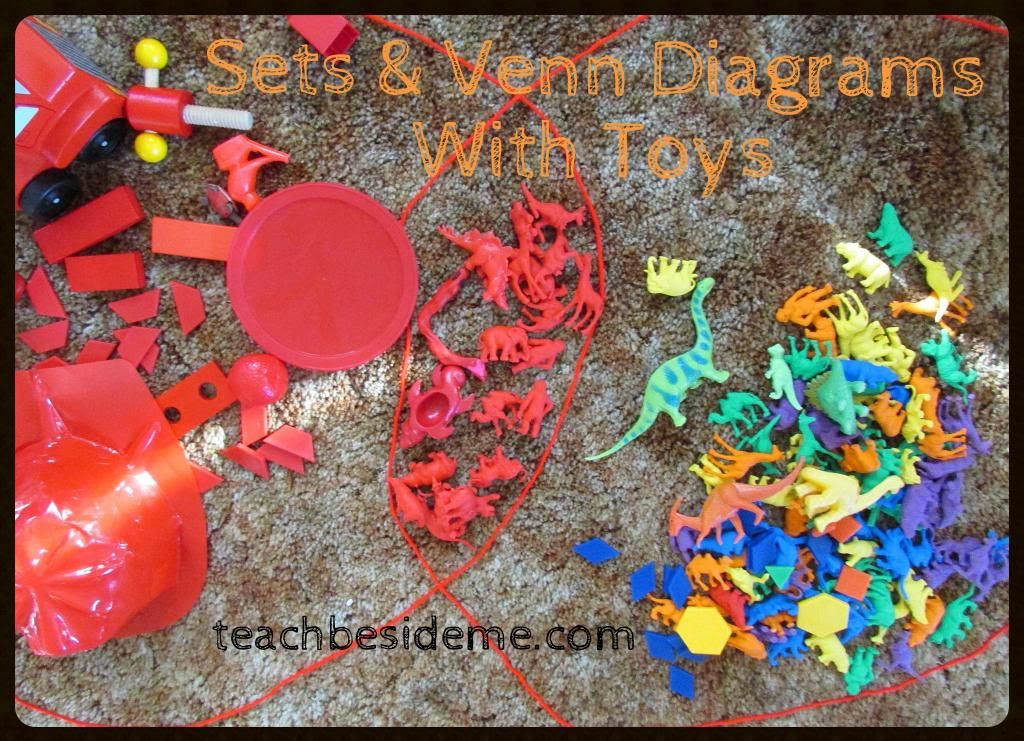
Create Two Circles with your yarn on the floor. Overlap them slightly in the center to form a basic Venn diagram.
Label Your Sets. For example, we labeled one circle “Animals” and the other “Red Toys.”
Sort the Toys. Let kids decide where each toy belongs:
- In the “Animals” circle
- In the “Red Toys” circle
- Or in the overlapping section (for red animals!)
Discuss as You Sort. Ask guiding questions like:
-
-
Why does this toy go here?
-
Does this toy fit both categories?
-
Could we add a third set?
-
Why This Sets & Venn Diagrams Activity Works
Hands-on math activities like this are incredibly effective for young learners because they:
-
Encourage active learning
-
Build logical reasoning and critical thinking
-
Make abstract concepts concrete
-
Reinforce sorting, categorizing, and comparing skills
-
Foster independent thinking and discussion
Extensions and Variations:
-
Try with three overlapping circles and more complex attributes
-
Use seasonal items (e.g., pumpkins and things that are orange)
-
Graph the number of items in each section afterward
-
Have kids draw their own Venn diagrams on paper
-
Create silly sets for fun (e.g., things that are squishy vs. things that make noise)
Book Pairing:
If You Were a Set by Marcie Aboff is part of a great math picture book series that also includes books on even/odd numbers, addition, subtraction, and more. Reading before or after the activity reinforces the vocabulary and gives kids another way to understand the concept.
Educational Benefits:
This activity integrates math, literacy, and critical thinking. It supports:
-
Early set theory concepts (a foundation for data and probability later on)
-
Vocabulary building (terms like “set,” “intersection,” and “attribute”)
-
Visual and kinesthetic learning styles
-
Cooperative learning when done with multiple children
Learning through play doesn’t have to be complicated. With just a few toys and a piece of yarn, you can build a memorable math experience your kids will love.




Looks like fun! I always forget about those silly diagrams!
We definitely need to try this tomorrow! Thanks for your comment too!
Wow this is really neat!! I will have to try this with my oldest. I would love it if you shared this on my Thursday link up party at http://www.teachingmama.org Hope to see you there!
Cool. We were just reading, “All Kinds of Families” by Mary Ann Hoberman. It would work with this activity as well because she focuses on sets (which she calls “families”) and then she also talks about human families! We’ll try your activity.
Hi there! Stopping by from the UBP13. I love this hands-on way to teach comparing and contrasting! Pinning. -Malia {Playdough to Plato}
I love this! Sometimes it just takes me seeing how wonderful something worked out, to decide to act on what I already knew how to do and do it with my own kiddos 🙂
My 8 year old son loves making Venn diagrams! Thanks for sharing at The Children’s Bookshelf.
Great idea. I love this. When I taught high school we used Venn diagrams all the time, but I like the more hands on version for young children.
love the creativity… who wouldn’t rather learn math this way! Thanks for sharing with us at Eco-Kids Tuesday!! Hope you come link up again today!
This is such a fun way to learn sorting and classifying… not to mention venn diagrams!
Very fun and creative way to create Venn diagrams. This way we can encourage kids to learn diagrams and concepts