Cross-Curricular Kitchen Lessons for Homeschool
This post may contain affiliate links.
Today I want to talk about homeschooling in the kitchen. I have some ideas for focus on Cross-Curricular Kitchen Lessons.
The kitchen is one of the best places for hands-on home learning. As a former home-economics teacher I love bringing my kids into the kitchen with me. Cooking is an essential life skill, but there is so much more to learn than just the skill of cooking.
Kitchen Lessons for Homeschooling
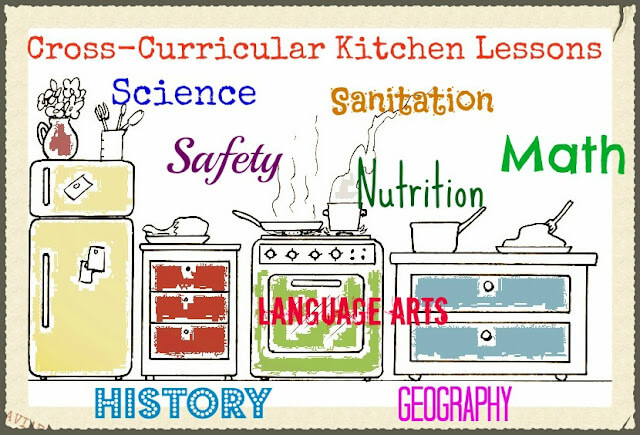
In the kitchen you can learn health and nutrition, science, math, safety, and sanitation, history & geography, even language arts! Start teaching you kids kitchen skills early by letting them help out in the kitchen while they are still young.
Cooking With Kids:
Children learn by using all of their senses and cooking definitely brings in all of the senses- touching, tasting, feeling, smelling, and listening. Children enjoy eating foods they help prepare. There are so many simple recipes that older kids can make on their own. Just make sure they wash their hands!
How to Get Kids involved in the Kitchen:
Scrubbing and peeling vegetables and fruits
Wiping tables and counters
Tearing lettuce
Pouring ingredients into a batter
Mixing batter and other foods
Spreading peanut butter on bread
Kneading bread dough
Juicing oranges, lemons, and limes
Mashing soft fruits and vegetables
Measuring dry and liquid ingredients
Rolling out dough
Help planning meals
Gathering ingredients for recipes
Unloading the dishwasher
Washing dishes
Nutrition Lessons in the Kitchen:

Kids can learn so much about health and nutrition by helping in the kitchen. You can teach them about eating a balanced meal. You can model good health and teach them by example.
See my visual recipes! I have them for German Pancakes, Pizza & Peanut Butter Balls.
I created a whole kids nutrition unit a few months back. You can see it in this post.

Math Kitchen Lessons:
One of the most important kitchen lessons is learning fractions! Math is a huge part of cooking. You have to know a little about fractions to be able to read and carry out a recipe.
I remember when I was teaching foods classes at the high school, the kids who did not have a firm grasp on fractions really struggled with reading and understanding recipes. I have started teaching my kids fractions at a young age so they can understand the concept. Also, be sure to teach them about measuring cups and spoons so they understand what they are.
More ideas for math in the kitchen:
- Metric measurements & conversions -most liquid measuring cups have the metric measurements on the cups
- Doubling or halving a recipe
- Basic fractions using measuring cups- let them play around & measure dried beans.
- Measuring equivalents (How many tablespoons in a cup, cups in a pint, quart, gallon, etc.)
Science Kitchen Lessons:
There is so much science happening in the kitchen. You can really have fun with this!! Think of all of the reactions that happen while baking. We all know about baking soda and vinegar, but there is so much more. Why do we use eggs, oil, or baking soda in cookies, cakes, or muffins. What would happen if any of these things were left out? Try it out and see!
Who knew there was so much chemistry involved in baking? I took a whole class on it in college- it is so fascinating!!!
There are HUNDREDS of simple experiments you can do with basic kitchen ingredients.
We did a fun experiment for baking a cake HERE. Also see our Apple Science experiment and our experiment to Turn Juice into a Solid! Try Making Butter in a Jar or Bread in a Bag! Make some Homemade Hard Candy Lollipops.
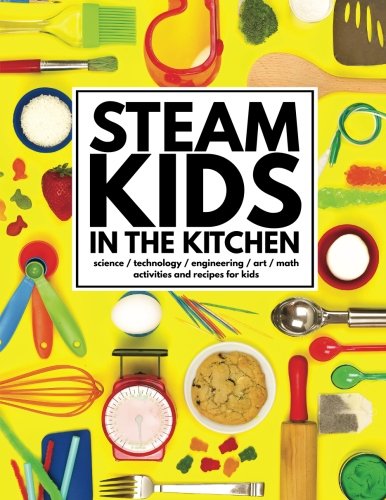
Check out my book: STEAM Kids in the Kitchen
- What is the difference between baking soda and baking powder? What would happen if you switched them in a recipe? There is a great experiment and detailed description HERE.
- What makes a cookie flat and crunchy vs. soft & chewy? Find out all the answers on THIS site.
- There is a whole section of cooking and baking science project experiments on THIS site.
- Learn about the states of matter- solids, liquids and gasses.
- Learn about temperature- Fahrenheit & Celsius
- Why do we need heat in cooking? What does it do to our food?
- Show you kids what happens whet you beat egg whites.
Geography Kitchen Lessons:
- Learn where your food comes from- print a map and mark on the map where your produce comes from (it is on the little stickers!)
- Learn the ethnic origin of different meals. Try this fun Spices from around the world activity!
- Cook ethnic meals from around the world while you study them.
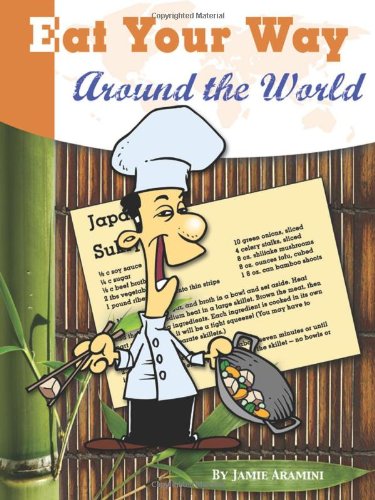
We love the book Eat Your Way Around the World!
History Kitchen Lessons:
When did we start eating different types of foods? Visit the Food Timeline website to learn more about it. Learn how foods are made/grown. There are many online/virtual factory tours you can take.
What were typical meals in the time period you are studying in history? Make meals from that time period. We love making Irish Soda Bread!
Safety & Sanitation Kitchen Lessons:
Sanitation is not just about hand washing. Kids need to learn the importance of keeping their cooking space clean and sanitary. They also need to learn the basics of food handling. It is important to wash produce. Teach them about raw meats and the need to clean hands and the cooking area you work with while handling them. Keep raw meats away from fresh foods. Teach them the importance of refrigeration and the shelf-life of foods.
Safety issues can include handling knives (you can determine when you feel your kids are able to use knives safely), using the stove, microwave cooking (no metal in the microwave), keeping flammable items away from the stove, how to put out a grease fire (sprinkling baking soda on it).
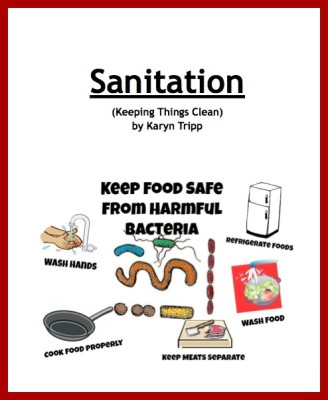
I wrote a little mini book for kids on Safety and Sanitation. It’s available in my shop.
Language Arts Kitchen Lessons:
Even language arts can be taught in the kitchen! Kids can practice their reading skills by learning to read a recipe. Get out a cookbook and let them read through it to find something that looks good to them, then let them help you make it. Let them help you figure out what ingredients you need and teach them where to find them in the kitchen.
Help your kids start their own recipe file box. They can copy their favorite recipes onto index cards and keep adding to them as the years go on. This is something valuable that they can take with them when they go to college or move away from home someday.
They can learn new vocabulary words in the kitchen. Teach them recipe terms. Make a food notebook of recipe terms. Many cookbooks have a glossary of cooking terms in the front or back to help you in reading a recipe.
Above all, have fun in the kitchen with your kids. You are teaching them valuable skills that will last a lifetime. The foods you make and the time you spend doing it with them and for them will last with them forever. You are making memories!



I took the same approach with my post! I absolutely love your graphic at the top with all the subjects listed!! Pinned this!!!
This is excellent! I am pinning this for my girls. Thanks so much!
We love kitchen-schooling, too!
Great ideas! I especially love the activity for having your child start a recipe box. This is definitely something they will use for the rest of their life, and they can pass it down to their child.
I follow a neat blog about nutrition and cooking with kids. She usually includes hands-on ideas and activities. Here is the link: http://nutritionforhealthykids.blogspot.com/
Joyfully,
Jackie
Cooking really can teach you so many things, not just how to cook!
Thanks for linking up to Science Sunday
very clever!
Wow! I didn’t think of teaching geography or history in the kitchen. Great ideas! Thanks for sharing at Mom’s Library.
Isn’t it amazing all that emcompasses “learning and educating”!!
Thanks for sharing with us at Eco-Kids Tuesday! Hope you join us again today! http://likemamalikedaughter.blogspot.com/2013/03/flip-trainer-review-at-eco-kids-tuesday.html
That is smart to cross teaching the children to cook with academic lessons. I have written my first Home Ec, Beginning Cookin book and I included some ideas to dig deeper, but I didn’t think about crossing it with history, math, etc… and make it more academic. Very cool!