
Rainbow Paper Towel Experiment: Walking Water Science for Kids
This post may contain affiliate links.

We had fun this week doing a few different kinds of rainbow science. Have you ever tried the rainbow paper towel experiment? It’s an awesome way to explore capillary action, color mixing, and absorption through a hands-on STEM activity!

This is an update on a post I did more than 10 years ago. I love freshening up my older posts with better pictures, but I also enjoy re-doing favorite activities with my younger kids. Seeing their joy and wonder makes it feel brand new every time!
In this easy science experiment, we explored how paper towels absorb water and how colors blend to form a walking rainbow. The kids loved these simple experiments and learned all about primary and secondary colors while observing the science behind absorption.
We actually did two versions of this experiment—both simple, fun, and using items you already have at home!
.
Rainbow Paper Towel Experiment: Walking Water
The first experiment we did is called the rainbow walking water experiment. This classic color-mixing experiment is perfect for introducing young learners to scientific concepts like capillary action, color absorption, and liquid movement.
Materials Needed:
6 clear cups or jars
Paper towels
Food coloring (or liquid watercolors) in red, yellow, and blue
Water

We used 6 small plastic cups for ours.
Watch it in action:
How to Do the Rainbow Paper Towel Experiment
Step 1: Set Up the Cups
-
Fill three cups with water and leave the other three empty.
-
Add food coloring to the three cups of water, using the primary colors: red, yellow & blue.

Step 2: Arrange the Cups
-
Place the cups in a circle or a straight line.
-
Put an empty cup between each colored cup.
-
Make sure the cups are close together so the paper towels can connect them.

Step 3: Fold & Insert the Paper Towels
-
Fold paper towels into long strips (folding into thirds works well).
-
Adjust the size to fit inside your cups if necessary.
-
Insert one end of a paper towel into the colored water and the other end into an empty cup.

Step 4: Observe the Color Mixing
-
The water begins soaking up the paper towel and moves toward the empty cups. You can see the water climb slowly up!
-
As the colors mix, you will see secondary colors form:
-
Yellow + Blue = Green
-
Red + Blue = Purple
-
Red + Yellow = Orange
-

It takes time! Let your kids watch and check in throughout the day.
Tip: Using smaller cups makes the process faster!

The Science Behind This Rainbow Paper Towel Experiment
Why does this happen? The walking water science experiment works due to a scientific principle called capillary action.
What Is Capillary Action?
Capillary action is the ability of a liquid to move upward through small spaces, seemingly defying gravity!
Plants use capillary action to pull water from the soil up through their roots and stems to reach their leaves. In this experiment, the paper towel acts like a plant stem, pulling water upward and transferring it to the empty cup.
-
Adhesion: Water molecules stick to the fibers of the paper towel.
-
Cohesion: Water molecules pull each other along as they move upward.
-
Gravity vs. Capillary Forces: The small spaces in the paper towel allow the water to travel against gravity.
This experiment also works because of cellulose fibers, which make up the structure of the paper towel. These natural fibers, found in plants, create tiny channels that allow water to travel upward through capillary action. This simple experiment helps kids visualize how water moves through plants and introduces basic principles of physics and chemistry!
Rainbow Science: Absorption with Paper Towels
For our second rainbow paper towel experiment, we explored how absorption works by making a rainbow appear!
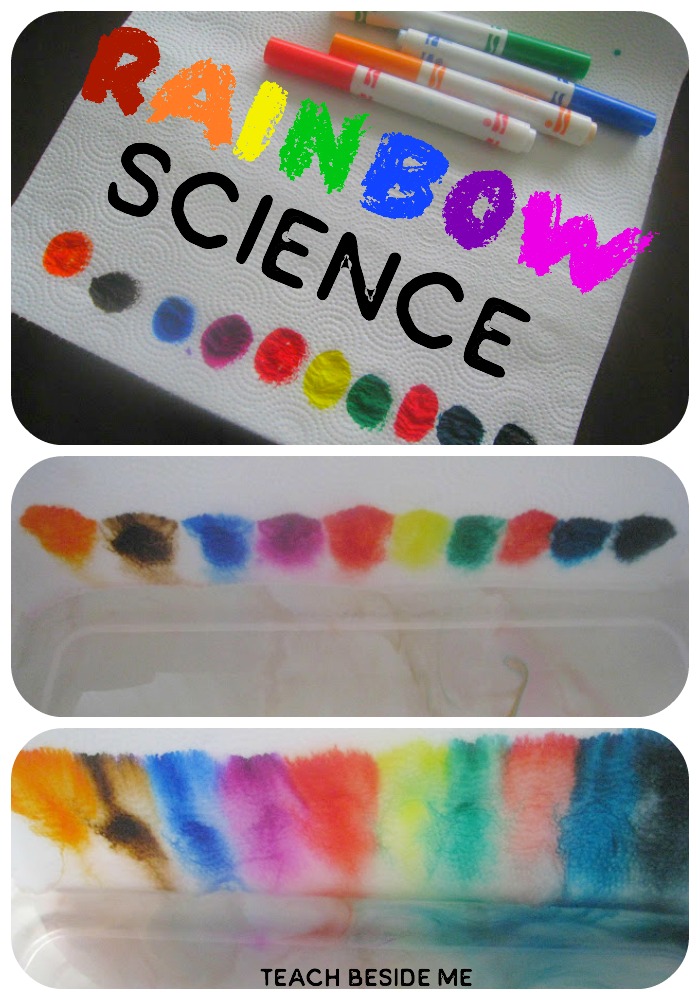
Materials Needed:
1 paper towel
Water-based, washable markers or food coloring
A shallow dish or clear plastic container
Water
How to Do It:
-
Draw large colored circles on the bottom edge of a paper towel, leaving some white space below the colors.
-
Fill a shallow dish with water, adding just enough to reach the bottom of the paper towel.
-
Place the paper towel into the water, letting it hang over the edge.
-
Watch as the water moves up the paper towel, pulling the colors along with it to create a beautiful rainbow effect.
The Science Behind It
This experiment also demonstrates capillary action, but in a different way:
-
The water molecules travel upward through the paper towel.
-
The colors are carried with the water, showing how liquids can transport substances.
This version of the experiment is especially fun for kids who love art and color mixing! It is also a quicker experiment and would be fun for preschool or other younger kids.
The water soaks up the paper towel bringing all of the colors with it making a wonderful rainbow. My daughter who loves painting and colors was just so excited about this. She thought it was beautiful!!
Ways to Extend the Experiment
Want to take the rainbow paper towel experiment even further? Try these variations:
- Use different paper towels – Test different brands and textures. Which one absorbs water the fastest?
- Experiment with other liquids – Try saltwater, vinegar, or sugar water. Do they absorb differently?
- Make color predictions – Ask kids to guess what new colors will form before they appear.
- Try a bigger setup – Use taller containers and longer paper towels for a giant rainbow effect!
These rainbow paper towel experiments are a fun, colorful way to explore science with kids! Whether you’re learning about capillary action, absorption, or color mixing, this hands-on project provides a visual, engaging learning experience.
If you enjoyed this rainbow science experiment, pin it for later or share it with a friend who loves simple STEM activities!
What did your kids discover? Share your results in the comments below!
See a FULL Lesson on This Activity & More Chromatography + Capillary Action Activities Here:
See More Rainbow Science Experiments!
DIY Rainbow Water Xylophone: Easy Sound Science Experiment
Magic Paper Towel Experiment: Hidden Rainbow Science for Kids
Rainbow Play Dough Color Mixing



This is great!!! It would be fun to do after dying Easter eggs, too! 🙂
Thanks for sharing with my Super Link Party! 🙂
What a cool idea!
Thanks for linking up to TGIF! Have a great week =-)
Beth
This is an excellent project and thank you so much for sharing. Children are so impressed with experiments like this and they are so memorable. Thank you so much, Carolyn
Awesome! We’ve been reading the book, “Mouse Paint” this week and these would be some great color experiment to go along with our reading.
This is great! I was trying to think of something fun to do today and this is it! Can’t wait to try it. Thank you!
Tonya
We just finished both experiments and they are so cool! Thanks for sharing!
This is a great idea. It is a fun way to learn and the colors are so vibrant. Please stop by and link this post (and any other arts, crafts and play posts) to Artsy Play Wednesday on Capri + 3. I hope to see you there.
: 0 ) Theresa
http://www.multiples-mom.com
I love this, so many different ways to teach absorption. I love the cups one, it’s one of my favorites.
Thanks for linking up to Science Sunday!
I love this activity and your approach to it. Thank you for linking up to The Sunday Showcase. I’ll be featuring you tomorrow.
What a great experiment/activity. I featured it on this week’s Sunday Showcase – thanks for sharing with us! Can’t wait to try it with my girls.
We are doing this today! Thanks for the inspiration. And thank you for linking up to Discover & Explore. I’m featuring this post today.
Amazing!! I love this activity. Thanks for the idea, i’ll try with my student